


Nebraska's small-grains program produces award-winning wheat for baking
Lincoln, Nebraska, May 20, 2026 — For generations, the University of Nebraska–Lincoln’s small-grains breeding program has produced new wheat varieties that offer robust yields and disease resistance. Now, the program has produced a wheat line that is a standout on an additional dimension — superior milling and baking quality. And private industry is cheering.
Specifically, the national Wheat Quality Council has selected Nebraska’s hard red winter wheat line NE20620 for the Miller’s Choice Award 2026.
This is no half-baked honor.
It is a regional award that points to exceptional quality for milling, mixing and baking, determined through rigorous blind tests by multiple testers with the Wheat Quality Council, a nonprofit organization that brings together breeders, producers, processors and bakers.
In earning the honor, Nebraska beat out breeding programs from other public universities and private industry in an annual competition involving about 25 wheat lines.
NE20620 has shown impressive all-around strength. It provides Nebraska producers with impressive yield and disease resistance on the front end. At the same time, it gets an enthusiastic thumbs-up from millers and bakers on the back end.
“It has fantastic disease resistance, great yields and great end-use quality,” said Katherine Frels, assistant professor of agronomy and horticulture and director of the Small Grains Breeding and Genetics Program.
The honor points to the variety’s additional high performance when a milling company processes it and a baker converts it into bread.
As part of the national program, Frels said, testers “mix and then bake little loaves and evaluate them: How much did the loaf rise? Is it shaped normally or is it misshapen? Does it have a lot of holes in it? Does it make a nice, clean, white slice, or is it kind of yellow or gray?”
The council compiles the testers’ findings into a massive book that culminates in a ranking for each variety. The council’s milling and baking company members then discuss the leading varieties and decide on the overall winner, as well as other strong contenders.
The companies voted to include NEB-148-42, a second hard red winter wheat line entered by Nebraska, among those strong contenders.
The university is building up the NE20620 seed stock for expected 2027 release, thanks in part to funding from the Institute of Agriculture and Natural Resources’ Agricultural Research Division and the Nebraska Wheat Board.
Nu Horizon Genetics, a farmer-driven 501(c)(5) nonprofit organization affiliated with the University of Nebraska–Lincoln, markets the university’s wheat varieties through members in Nebraska and Colorado.
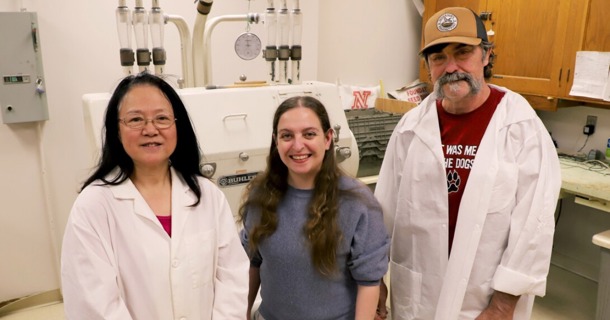
NE20620’s exceptional milling and baking performance is due to a team effort, Frels said, involving not only the technical genetic analysis and field work, but the detailed study of each line’s milling, mixing and baking qualities by the Department of Agronomy and Horticulture’s grain quality lab. Lan Xu, research manager, and Marc Walter, research technician, carry out the tests, with supervision by Devin Rose, professor of food science and technology and professor of agronomy and horticulture.
Xu’s evaluations include wheat grain milling performances, dietary fiber contents of the wheat varieties and flour properties such as protein content, viscosity and how well the dough responds to mixing, kneading and baking. She also studies the characteristics of final products such as bread, noodles and tortillas.
“It’s really a big collaborative effort,” Frels said. “I would not be able to have lines that meet this many quality metrics if we didn’t have Lan and Marc running that quality lab. It's not easy to mill, mix and bake wheat. They do a fantastic job of testing lines for me every year.”