


Gov. Pillen Holds Ceremonial Bill Signing for LB 1091 to Expand Access to Specialized Healthcare
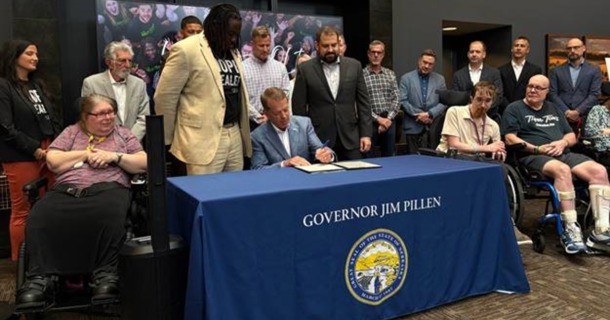
OMAHA, NE – On Wednesday, Governor Jim Pillen hosted a ceremonial bill signing for LB 1091, designed to protect and streamline specialized medical coverage for vulnerable patients. The event was hosted at Quality Living, Inc., which provides world-class rehabilitation and care to people from across the U.S. as well as Nebraska. Participants at the event included Senator Elliot Bostar, QLI board and staff members, representatives from Madonna Rehabilitation Hospitals and Ambassador Health, and clients from QLI.
Introduced by Sen. Bostar and passed unanimously by state lawmakers, LB 1091 ensures consistent, high-quality care for individuals with special and long-term medical needs under Nebraska’s medical assistance program.
“LB 1091 reflects a simple but importance commitment – Nebraskans living with traumatic brain injuries, spinal cord injuries, and other complex medical conditions deserve access to specialized care that gives them the best opportunity to reach their fullest potential and to do so with dignity,” said Gov. Pillen. “The partnership between our long-term special needs providers and the State of Nebraska has improved the lives of thousands of our most vulnerable residents and LB 1091 strengthens that partnership for what I know will be years to come.”
Historically, individuals requiring high-acuity long-term care such as those living with complex medical dependencies, faced prior-authorization roadblocks and administrative delays from Nebraska’s Medicaid managed care program. LB 1091 addresses these barriers by routing high-acuity long-term care through a direct fee-for-service structure under the Nebraska Department of Health and Human Services (DHHS).
Because Nebraska’s Medicaid managed care program relies on strict prior authorizations and utilization management to control costs, exempting high-acuity special needs care will eliminate unnecessary delays that can disrupt urgent or continuous treatment. Through close collaboration among healthcare providers, key stakeholders, DHHS, and the Health and Human Services Committee, the final legislation was structured to be cost-neutral.
“Passage of this legislation will ensure that Nebraskans with complex medical needs can access the highly specialized long-term care they need to recover, regain their independence and return home,” said Sen. Bostar. “Getting this bill across the finish line took collaboration among providers, families, DHHS, the Governor’s team, and my colleagues in the Legislature. I’m grateful to QLI, Madonna and Ambassador Health for their leadership and advocacy, and proud that Nebraska came together around a solution that puts patients and their long-term outcomes first.”
Healthcare leaders who partnered on the effort emphasized the law’s immediate impact on patients’ stability and access to specialized services.
“Our mission has always been about more than providing care. It’s about helping people rebuild their lives and showing them there can still be hope after a catastrophic injury,” said Nash Mahupete, President and CEO of QLI. “With LB 1091, the system helps to get them that care, not stand in their way.”
“LB 1091 provides important stability for Nebraskans with complex medical and nursing needs who rely on specialized care,” stated Madonna Rehabilitation Hospitals. “Madonna Rehabilitation Hospitals was proud to partner with QLI, Ambassador Health, and state leaders to help advance this legislation. We are especially grateful to Senator Bostar for championing LB 1091, Senator Prokop for making it a legislative priority, and Governor Pillen for signing this important measure into law.”
“LB 1091 is a tremendous outcome for Nebraskans with medically complex needs, improving access to specialized services and coordination of care,” added Ambassador Health. “It is a great example of what Nebraska can accomplish when state leaders, providers, patients, and families work together. Ambassador Health is proud to have been part of that effort and to continue serving children with medically complex needs and adults requiring ventilator care.”
Under the bill, DHHS must amend Medicaid managed care contracts, including revisions to enrollment processes, no later than six months after the bill’s effective date.