

An unexpected internship opens new possibilities for NCTA student
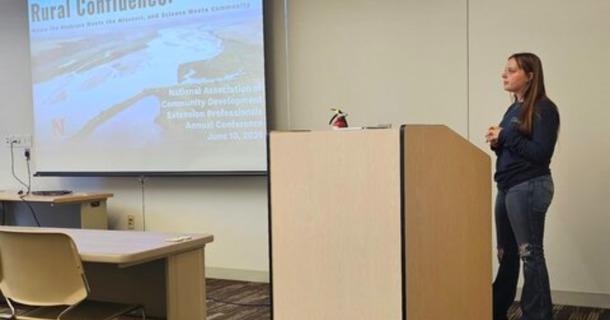
CURTIS, Neb. — Sam Durre, an NCTA student majoring in Livestock Industry Management and Agricultural Business, knew she wanted to work with cattle. She already had an internship planned that would support that interest when NCTA administrators encouraged her to consider a different opportunity. They suggested an internship with Rural Confluence, a grant-funded project focused on climate resilience in rural communities, including Curtis.
At first, Sam said no. The opportunity was outside her comfort zone and different from what she had pictured for herself. But she eventually decided to give it a chance, a decision she is now glad she made.
“I had my mind set on doing ranch work over the summer, but I’m glad I didn’t. Throughout this internship, I was reminded of how much I love learning. I never would have thought I would have the opportunity to be a published researcher. I can always go and work cattle, but I’ll never get an opportunity like that again,” Durre said.
Rural Confluence is a National Science Foundation-funded collaboration involving the University of Nebraska–Lincoln, Oklahoma State University, and Louisiana State University. The project brings researchers and rural residents together to better understand climate-related challenges and develop plans that reflect each community’s needs and priorities.
In Curtis, that work includes conversations about weather, water, fire, and preparing for future extreme events. NCTA hosted a community discussion in April 2026, inviting residents to help shape resilience plans for the area. Sam’s internship connected her with this broader effort to help rural communities prepare for the future.
Through the project, Sam met with and interviewed many Curtis residents, learning about the community’s history and hearing their experiences and perspectives firsthand. She also helped with drought action plans and evacuation planning, connecting her research with practical community needs. That preparedness work has become especially meaningful following fires in the area.
For Sam, the internship brought NCTA’s “Learn by Doing” approach into the community. She applied her learning to real community needs while discovering what she could accomplish outside her comfort zone.
Sam also brought an agricultural perspective to the project. Her studies in Livestock Industry Management and Agricultural Business helped inform the work, adding the viewpoint of a student focused on agriculture and its connection to rural communities.
Her experience introduced her to another side of rural life: how communities understand their past, prepare for challenges, and work together to plan for the future. It also challenged her to think in new ways.
When Sam shared her experience with NCTA’s first-year seminar students, her message was simple. Doing something unfamiliar had gotten her brain thinking, and she encouraged students to consider internships outside their own comfort zones.
For students preparing to choose an internship, her experience offers a reminder that learning can happen in unexpected places. An opportunity that does not immediately match a student’s career plans can still build confidence, expand interests, and reveal new ways to contribute.
Sam began with a clear interest in cattle. By trying something different, she gained a broader perspective on the rural communities where agriculture and everyday life are closely connected.
The Nebraska College of Technical Agriculture (NCTA) in Curtis is a two-year institution within the University of Nebraska system, dedicated to developing the next generation of agricultural professionals and veterinary technicians. NCTA offers specialized programs in Animal Science, Agronomy, Ag Equipment, Agribusiness Management, Agricultural Education, Equine Industry Management, and Veterinary Technology, all grounded in a practical, career-focused approach to learning.